
How Streaming Is Taking Ghanaian Music to New Audiences Worldwide
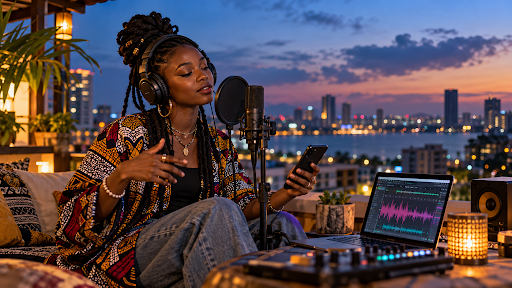
Spotify’s Top Tracks of 2025 Ghana list begins with an unusual run: every song in the top 15 involves Black Sherif, either alone or with another artist. “Sacrifice” sits at No. 1, followed by “Soma Obi” and “So It Goes,” while his 2022 track “Oil in my Head” still appears at No. 15. That is a useful picture of streaming culture because a release no longer disappears when radio programming moves on. A catalog can keep finding listeners for years.
A Release No Longer Needs One Gatekeeper
Streaming gives an artist several doors into the same audience. Black Sherif’s verified Audiomack account has accumulated about 1.27 billion plays, while “So It Goes” has passed 63 million plays there, “Sacrifice” 59 million and “Soma Obi” 37 million. His IRON BOY album alone has accumulated more than 400 million Audiomack plays since its April 2025 release. For an independent or developing act, promotion can now move between uploads, playlists, short clips, and direct posts instead of depending on one radio campaign.
Discovery Often Happens Before the Stream
TikTok has tightened the loop between hearing a fragment and saving the full song. Its Add to Music App feature generated more than 6 billion track saves to premium streaming services during the 12 months from April 2025 to April 2026, while TikTok for Artists became available in Ghana in August 2025 with analytics for music and fan activity. A short clip can therefore produce measurable behavior on Spotify or Apple Music rather than remaining a viral moment isolated inside one social platform. Discovery has become trackable.
Entertainment Apps Compete for the Same Hour
Music is only one category fighting for attention on the phone. Some adult users may leave a music stream to Visit Melbet Ghana, check a sports market, or open a digital game, then return to the same playlist without changing devices. Betting and casino products work differently from music platforms, because sports markets use odds tied to uncertain events, while casino games may rely on RNG, RTP, and volatility, but they belong to the same wider market for screen time. That overlap helps explain why music campaigns increasingly appear beside gaming clips, football discussions and creator content rather than inside a separate “music” corner of the internet.
Moliy Shows How Far One Clip Can Travel
Ghanaian-American artist Moliy supplied one of the clearest recent examples. “Shake It to the Max (FLY)” began as a 2024 release before the remix with Silent Addy, Skillibeng and Shenseea drove a larger 2025 breakout; that version debuted at No. 91 on the Billboard Hot 100 in May. The record then held No. 1 on Billboard’s U.S. Afrobeats Songs chart for 22 consecutive weeks, while Spotify named the remix one of its five Songs of Summer and TikTok ranked it No. 8 on its global summer list. Billboard Africa reported in 2026 that the release had surpassed one billion streams.
The Regional Business Is Getting Larger Too
The audience growth is visible in industry revenue rather than only viral clips. IFPI reported that recorded-music revenue in Sub-Saharan Africa rose 15.2% in 2025 to $120 million, after the region first crossed $100 million in 2024 with revenue of $110 million. South Africa remained the largest market and accounted for 78.1% of the region’s 2025 revenue. Ghanaian artists are therefore entering a regional recorded-music business that is still concentrated but materially larger than it was two years ago.
One Device Now Holds the Whole Entertainment Stack
The same distribution logic applies outside music: install once, sign in and keep the service available whenever attention shifts. An adult who chooses to download MelBet android puts sports markets, casino games and account tools on the same type of device already carrying Spotify, Audiomack, TikTok and YouTube. For artists, that competition makes the first seconds of a song, a recognizable visual and a shareable clip more valuable because another entertainment option is always one tap away. For listeners, the boundaries between music, sport, games and social media are increasingly determined by the next notification rather than separate pieces of hardware.
A Small Release Can Leave Accra Very Quickly
An emerging Ghanaian act no longer needs to choose between “local” and “international” promotion on release day. A practical campaign can put the full track on streaming platforms, cut several vertical clips for social feeds, watch which cities start responding, and concentrate promotion where listener data shows real activity. Spotify for Artists provides audience segments, stream sources, and top-city data, while Audiomack exposes plays and playlist activity on public artist pages. Geography still shapes the music; it no longer dictates where the first serious audience must live.