
The Rare Blue Micromoon: Why Tonight’s Sky Holds a Celestial Phenomenon
Reason Why Tonight’s Sky Holds a Celestial Phenomenon
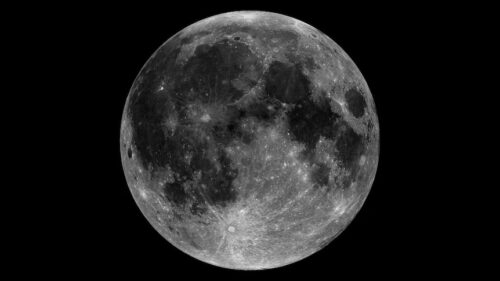
Tonight’s full moon will be a special sight for those watching the sky, but not in the way you may expect. If you are looking for a bright blue moon or a large lunar disk, you might be disappointed. Instead, the sky will showcase a rare event: a Blue Micromoon.
What is happening up there? Why is it considered rare, and why isn’t the Moon actually turning blue? Let’s look at the science behind this event.
What is a Micromoon?
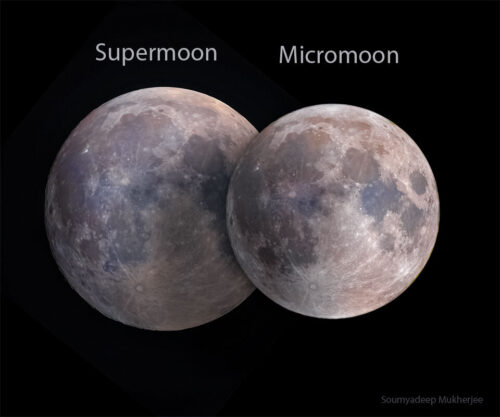
If you have heard of a “supermoon,” think of a micromoon as its polar opposite.
The Moon orbits the Earth in an oval-shaped (elliptical) path rather than a perfect circle. This means there are points in its orbit where it is closer to Earth and points where it is further away.
-
Apogee: The point in the orbit where the Moon is at its furthest distance from Earth.
-
Perigee: The point where the Moon is at its closest.
A micromoon occurs when a full moon coincides with the Moon’s apogee. Because it is physically further away, it appears slightly smaller and dimmer to our eyes than a typical full moon.
While the difference in size might be difficult to detect with the naked eye alone, it is undeniable when compared side-by-side with other moons. In fact, tonight’s event is particularly special because it is the smallest and dimmest micromoon of the entire year, occurring at a distance of approximately 406,368 kilometers from Earth.
The Mystery of the “Blue Moon”
The term “Blue Moon” often causes confusion. Despite the name, the Moon will not change color.
In modern astronomical terms, a Blue Moon is simply the label given to the second full moon within a single calendar month. Because the lunar cycle is roughly 29.5 days, it is rare for two full moons to squeeze into the same month—it typically happens only every two to three years.
If it’s not blue, where did the name come from?
The term is actually a result of a 20th-century “calendrical goof.” In 1946, Sky & Telescope magazine published an article that misinterpreted how the term had been used in the Maine Farmers’ Almanac. The mistake was widely picked up, and the term stuck.
Has the Moon ever been blue? Rarely, yes. However, it requires a major atmospheric event, not a calendar quirk. Following the 1883 eruption of the Indonesian volcano Krakatoa, the atmosphere was filled with volcanic ash particles roughly 1 micron in size. These particles acted as a filter, scattering red light while allowing blue light to pass through. For nights following the eruption, observers actually reported seeing a blue-tinted moon!
Enjoyed Reading The Rare Blue Micromoon: Why Tonight’s Sky Holds a Celestial Phenomenon, Checkout: West Coast Eagles vs Essendon: Can the Bombers Find a “New Coach Bounce” at Optus Stadium?
Why Tonight’s Event is Extremely Rare
While micromoons happen periodically and blue moons appear every few years, having both occur simultaneously is a significant rarity.
According to experts at the Astronomy Picture of the Day blog, these events don’t align often. While we see micromoons regularly and the next blue moon will arrive in 2028, the next Blue Micromoon is not forecasted to occur again until 2053.
How to Enjoy the View
Even if it appears slightly smaller than a standard full moon, the “smallest moon of the year” is still a beautiful sight.
-
Look just after sunset: The Moon will be at its most atmospheric as it rises.
-
Use photography to compare: If you are an amateur photographer, you might want to try capturing this moon. By using the same camera settings and focal length, you can document the subtle size difference compared to a future full moon.
Tonight, remember how our night sky is always changing. Even when the Moon appears smaller, it still connects us to our planet. Enjoy the view!