Mind-Bending Mandela Effect Examples: Why Our Memories Deceive Us
Why Your Brain Is Lying to You: Uncovering the Most Mind-Bending Mandela Effect Examples That Defy Reality
Have you ever been totally sure about something, only to find out you were completely wrong?
A few years ago, I was in my living room debating a movie quote with a friend while we watched Star Wars. When the famous scene came on, I shouted, “Luke, I am your father!” My friend laughed and pointed at the screen. I was shocked. The actual line is “No, I am your father.” I felt a strange chill, like something was off.
This experience isn’t just a funny memory; it’s a real thing called the Mandela Effect, which affects millions of people.
What is the Mandela Effect?
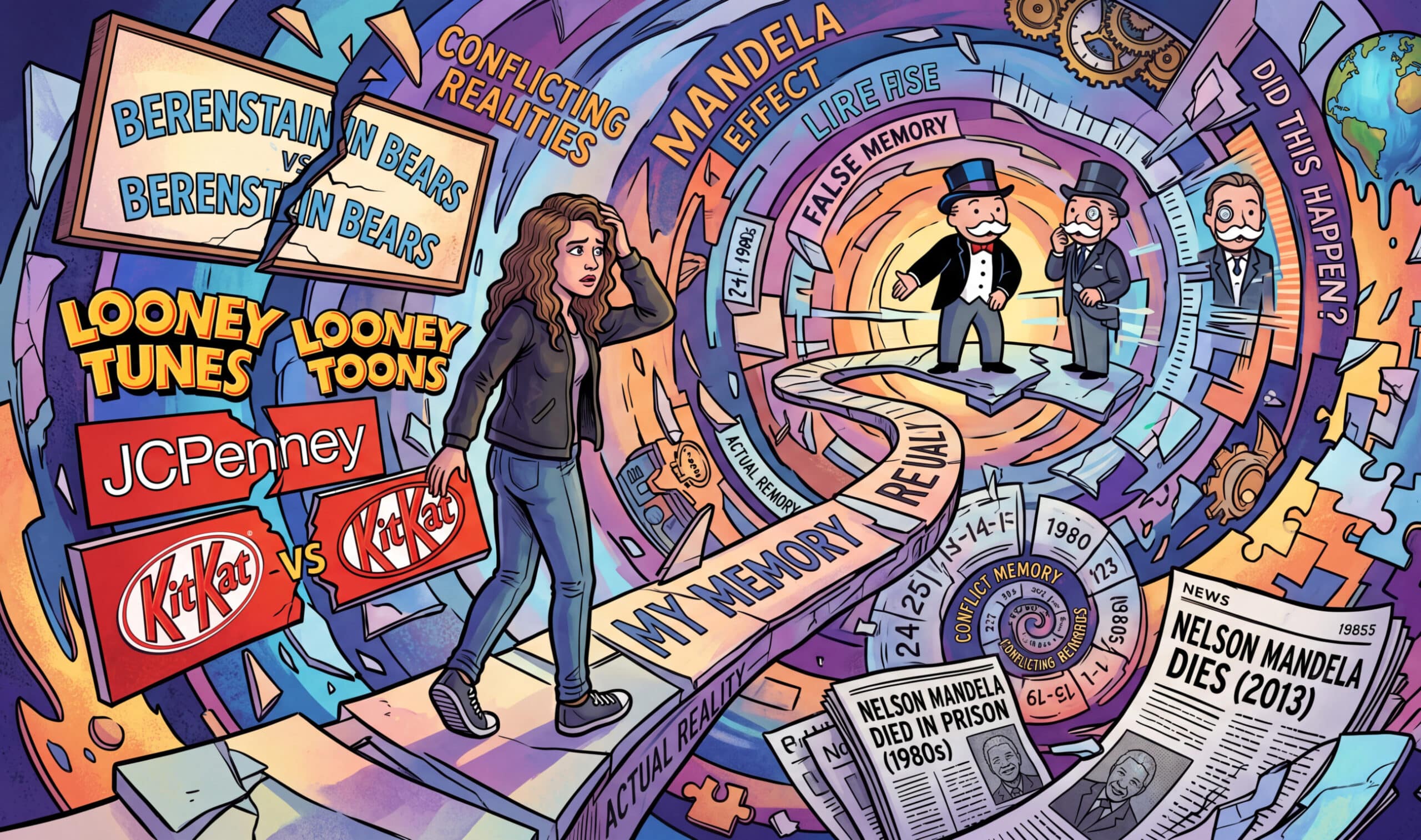
Fiona Broome, a paranormal researcher, created the term after she found that many people shared the same false memory: they believed Nelson Mandela died in prison in the 1980s. In reality, he became the President of South Africa and passed away in 2013.
When people discover that their shared beliefs are wrong, it can feel unsettling. But why does this happen?
Why Do Our Brains Betray Us?
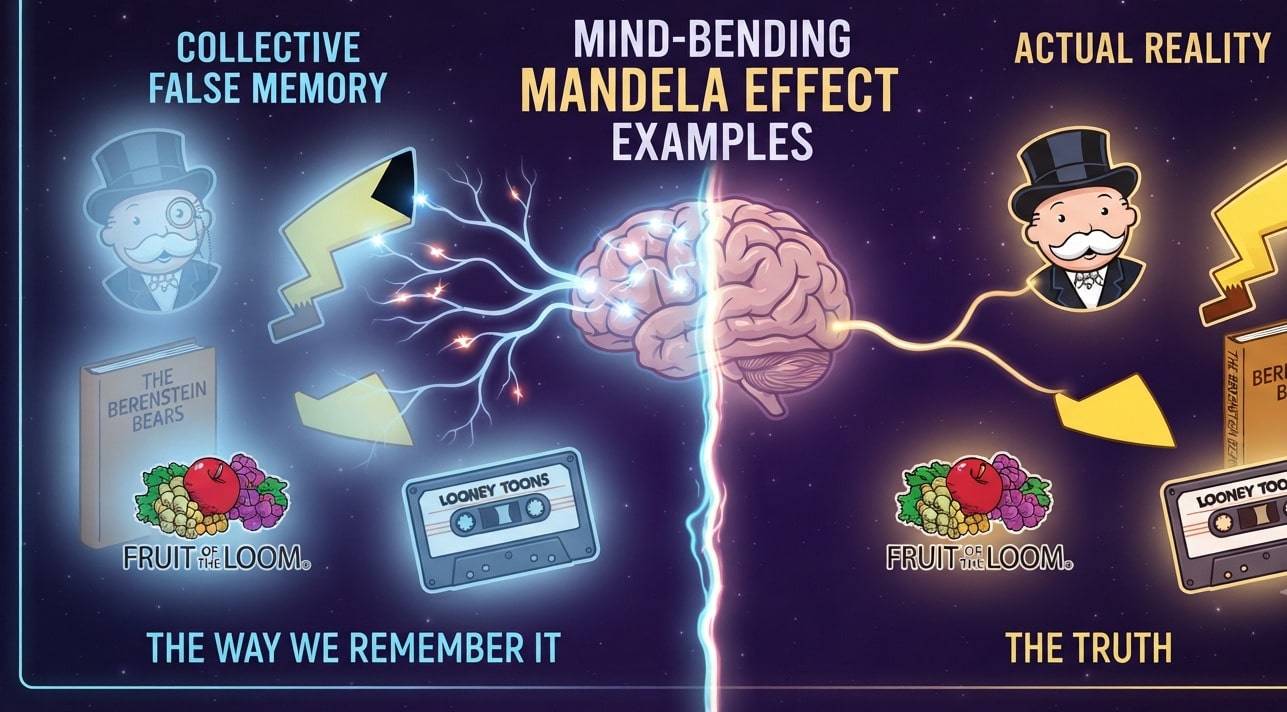
Experts like Dr. Wilma Bainbridge from the University of Chicago say that our memories can be influenced by what we expect to see. We don’t remember events like a video camera. Instead, our brains fill in the gaps based on our expectations. For example, the Monopoly Man doesn’t actually wear a monocle, but many people think he does because we link that look to “wealthy 19th-century gentlemen.”
When a false memory is shared on social media, many people start to “remember” something that never happened.
Mind-Bending Mandela Effect Examples
Ready to question your own reality? Here are some of the most famous examples that continue to baffle people:
-
The Berenstain Bears: You likely remember it as “Berenstein” with an ‘e’. It has actually always been spelled with an ‘a’.
-
Shazaam: Many people vividly recall a 90s movie starring the comedian Sinbad as a genie. It never existed. (Most think this is a mix-up with Shaquille O’Neal’s Kazaam).
-
The Monopoly Man: As mentioned, he has never worn a monocle.
-
Looney Tunes: It feels like it should be “Toons” (short for cartoons), but it has always been “Tunes.”
-
Pikachu’s Tail: Many swear there was a black tip on Pikachu’s tail. It’s entirely yellow.
-
Sex and the City: It wasn’t “Sex in the City.” It was always “Sex and the City.”
-
Kit Kat: There is no hyphen. It’s just Kit Kat.
ALSO CHECKOUT: Birthday Wishes to Celebrate Your Son’s Special Day: Messages from the Heart
Pop Culture & Historical “Mandela Moments”
Beyond brands and logos, some of our favorite movie lines and historical moments are victims of this phenomenon:
| Misremembered Quote | The Actual Reality |
| “Luke, I am your father.” | “No, I am your father.” |
| “Mirror, mirror on the wall.” | “Magic mirror on the wall…” |
| “Beam me up, Scotty.” | “Scotty, beam us up.” |
| “Life is like a box of chocolates.” | “Life was like a box of chocolates.” |
| “Play it again, Sam.” | “Play it once, Sam.” |
How to Avoid Falling for the “False Memory” Trap
We can’t always control how our brains take in information, but we can be more aware of it. The next time you argue about a movie quote or a logo, take a moment to look up where it comes from.
The Mandela Effect shows us that our brains create stories rather than storing perfect memories. Whether it’s filling in gaps or something stranger, these examples show that we sometimes remember history incorrectly.
Which “Mandela Effect” surprised you the most? Do you still believe the Monopoly Man wore a monocle? Share your thoughts in the comments below!
Frequently Asked Questions (FAQs)
What is the Mandela Effect?
The Mandela Effect is when many people remember an event, a fact about pop culture, or a detail differently than how it really happened. It is named after Nelson Mandela because many people mistakenly thought he died in prison in the 1980s.
Is the Mandela Effect caused by parallel universes?
Many people believe that the Mandela Effect happens because of “glitches in the matrix” or alternate realities. However, scientists and psychologists say it is due to our brain’s memory flaws. Memory is not like a video recorder; instead, it reconstructs what we remember. This means our brains often fill in gaps based on what we expect, what others say, and suggestions we receive.
Why do so many people have the same false memory?
This happens because of social reinforcement. When someone shares a false memory online, others with similar but unclear memories see it and accept it as true. This leads to a “snowball effect” where the shared wrong memory becomes more common in people’s minds than the actual, verified facts.
Can I “fix” my memory of the Mandela Effect?
You may not be able to change how your brain remembers something, but you can correct the mistake by returning to the original material. Watching the movie scenes again or looking at official brand logos can help refresh your memory. However, for a while, you might still feel strange about being so sure of the wrong information.
Are there any real-world consequences to the Mandela Effect?
Many examples of the Mandela Effect are fun, like discussions about a cereal brand or a movie quote. However, these examples show how unreliable our memories can be in legal or historical situations. They remind us that our perceptions can be easily influenced.